Saturday, 4 November 2017

Compaction Factor Test

Compaction Factor Test is designed in such a way that it can be used only in laboratory but in some cases, it can be used for field concrete tests. The compacting factor test has been developed at the Road Research Laboratory in United Kingdom. This test is one of the most accurate test performed in order to determine the workability of concrete.

AIM: To determine the workability by compacting factor test.

APPARATUS:
  1.    Compaction factor testing machine,
  2.    Trowels,
  3.    Hand scoop (15.2 cm long),
  4.    Standard tamping rod  (1.6 cm diameter, 61 cm long rounded at one end),
  5.    balance.
FIGURE:

THEORY: 
This is defined as the ease with which concrete can be compacted fully without Segregating and bleeding. It can also be defined as the amount of internal work required to fully compact the concrete to optimum density. The workability depends upon the quantity of water, grading, shape and the percentage of the aggregates present in the concrete. 
To test the workability of freshly mixed concrete, compaction factor test is carried out. This test works on the principal of determining the degree of compaction achieved by standard amount of work done by allowing the concrete to fall through a standard height. The degree of compaction factor is the ratio of weight partially compacted concrete to the weight of fully compacted concrete.


Dimensions of Compaction factor testing machine:

Description
Dimension CM
Upper Hopper, A

Top Internal Diameter
Bottom Internal Diameter
Internal Height
25.40
12.70
27.90
Lower Hopper, B

Top Internal Diameter
Bottom Internal Diameter
Internal Height
22.90
12.70
22.90
Cylinder, C

Internal Diameter
Internal Height
15.20
30.50
Distance between bottom of upper hopper and top of lower hopper
20.30
Distance between bottom of lower hopper and top of cylinder
20.30
PROCEDURE:
1.   Ensure the apparatus and associated equipment are clean before test and free from hardened concrete and superfluous water.
2.   Weigh the bottom cylinder to nearest 10gm, put it back on the stand and cover it up with a pair of floats.
3.   Gently fill the upper hopper with the sampled concrete to the level of the rim with use of a scoop.
4.   Immediately open the trap door of the upper hopper and allow the sampled concrete to fall into the middle hopper.
5.   Remove the floats on top of the bottom cylinder and open the trap door of the middle hopper allowing the sampled concrete to fall into the bottom cylinder.
6.   Remove the surplus concrete above the top of the bottom cylinder by holding a float in each hand and move towards each other to cut off the concrete across the top of cylinder.
7.   Wipe clean the outside of cylinder of concrete and weigh to nearest 10gm.
8.   Subtract the weight of empty cylinder from the weight of cylinder plus concrete to obtain the weight of partially compacted concrete.
9.   Remove the concrete from the cylinder and refill with sampled concrete in layers.
10.Compact each layer thoroughly with the standard Compacting Bar to achieve full compaction.
11.Float off the surplus concrete to top of cylinder and wipe it clean.
12.Weigh the cylinder to nearest 10gm and subtract the weight of empty cylinder from the weight of cylinder plus concrete to obtain the weight of fully compacted concrete.
13.The compacting factor (CF) = (weight of partially compacted concrete) divided by (weight of fully compacted concrete).

RESULTS AND ANALYSIS:
Weight of the Empty Cylinder, W
Weight of the Partially Compacted Concrete, W1
Weight of the Fully Compacted Concrete, W2
Compacting Factor, (C.F) =(W1-W/W2-W)

CONCLUSION:
Value Of Compacting Factor
Standard Of Workability
0.95
Good
0.92
Medium
0.85
Low

Friday, 3 November 2017

Methods of Reducing Efflorescence in Newly Constructed Masonry Walls

Several methods and techniques are available to reduce the efflorescence in newly constructed masonry walls. Efflorescence reduction systems should be thoroughly executed otherwise the required result will not be achieved.


Satisfactory implementation of these methods requires extensive knowledge and adequate understanding of each system. Therefore, this article will explore various methods used to decrease potential efflorescence on bricks.

Methods to Reduce Efflorescence in Newly Constructed Masonry Walls

Reduction methods for Potential efflorescence in newly constructed masonry walls are as follow:
  • Reduction of water penetration into masonry wall
  • Expelling Penetrated or condensed water out of masonry wall quickly
  • Prevent the contact between bricks which are different in chemicals composition
  • Reduce quantity of efflorescence compounds in materials of masonry wall

Reduction of Water Penetration Especially Wind Driven Rain Water into Masonry Wall

There are several measures which can be used during the construction of masonry walls to decrease water that may ingress the wall. These measures are as follow:
  • Form a good bond between masonry units and mortar: A satisfactory bond between masonry units can be obtained if certain construction measures are considered while masonry wall are constructed.
  • For example, utilizing mortar compatible with masonry units, fill both bed and head mortar joints sufficiently when solid units are used, adequately fill bed and face shell joints if hollow masonry units are used, consolidate mortar joint from ousted face of the wall.
  • Take necessary measures to avoid water penetration, especially rain, into partially constructed walls and wall opening
  • Movement joints in the masonry wall should be designed, placed and filled in the best possible way.
  • Seal masonry wall-roof interface using flashing.
  • Protect masonry wall from rain water by building overhangs.
  • It is advised to either add suitable water repellent admixture to concrete masonry units or applying water repellent coating to the concrete masonry wall.
  • Masonry building components such as chimney cops, sills and copings should be constructed from solid masonry units, reinforced concrete, corrosion resistant metals or stone.
These components should be extended and exceed masonry wall face by 2.5cm and flashings and weep holes should be provided.
It is recommended to slope (preferably 1:4) these components and attached to the masonry walls. Not only does the movement joints should be properly sized and positioned but also sealed sufficiently.

Expelling Penetrated or Condensed Water Out of Masonry Wall Quickly

Penetrated and condensed water in masonry wall can be discharged by considering the following techniques:
  • Installing sound and durable weep holes and flashing at critical location of the masonry wall such as below window copings and sills, above lintels, masonry wall openings, roof-wall intersection and above ground level at the base of the wall.
  • Another way to quickly drain water out of masonry wall is through drainage placed in the air space of the drainage wall.
Masonry Wall Drainage System
Masonry Wall Drainage System

Prevent the Contact Between Bricks which are Different in Chemicals Composition

Contacts between different bricks in masonry wall can be prevented as follows:
  • Install separator between different materials of masonry walls.
  • Provide flashing or separator between masonry wall and other structural elements build from different materials for instance chimney caps, sills, and copings.
  • If cavity wall is constructed, it is necessary to provide at least 5cm between exterior masonry Wythe and interior wall constructed form different materials.

Reduce Quantity of Efflorescence Compounds in Materials of Masonry Wall

The reduction of efflorescence compounds in materials of masonry walls can be obtained through the following approaches:
  • Materials used on the construction of masonry walls such as masonry materials, water, admixtures and cleaning agents are recommended to be tested prior to the masonry wall construction.
  • The results of materials tests in combination with construction methods need to be estimated to find out their combine effect on the efflorescence in the future.
  • Masonry materials should be stored properly to prevent materials from moisture and contact with dissimilar materials otherwise the likelihood of efflorescence would increase.
  • Protect masonry construction materials during delivery to avoid contamination
  • If newly constructed masonry walls are cleaned, it is necessary to apply appropriate materials and procedure.

Thursday, 2 November 2017

Roles and responsibilities of a project manager

The roles and responsibility of project manager to make sure that the customer is satisfied and the work scope is completed in a quality manner, using budget, and on time. The Project Manager has primary responsibility for providing leadership in planning, organizing and controlling the work effort to accomplish the project objectives.

In other words, the project manager provides the leadership to project team to accomplish the project objective. The project manager coordinates the activities of various team members to ensure that they perform the right tasks at the proper time, as a cohesive group.

Roles of a project manager

Roles of a Project Manager

The different roles of project manager are as follows:
  • Planning
  • Organizing
  • Controlling
  • Leading
  • Communicating
  • Cognitive functions
  • Self management functions
  • Motivational and personal development functions
  • Customer awareness functions
  • Organizational savvy functions

Planning

First, the project manager clearly defines the project objectives and reaches agreement with the customer on this objective. The manager then communicate this objective to the project team in such a manner as to create a vision of what will constitute successful accomplishment of the objective. The project manager spearheads development of a plan to achieve the project objectives. By involving the project team in developing this plan, the project manager ensures more comprehensive plan than he or she could develop alone. Furthermore, such participation gains the commitment of the team to achieve the plan. The project manager reviews the plan with the customer to gain endorsement and then sets up the project management information system-either manual or computerized-for comparing actual progress to plan progress. It’s important that this system be explained to the project team so that the team can use it properly to manage the project.

Organizing

Organizing involves securing the appropriate resources to perform the work. First, the project must decide which tasks should be done in-house and which tasks should be done by subcontractors or consultants. For tasks that will be carried out in-house, the project manager gains a commitment from the specific people who will work on the project. For tasks that will be performed by subcontractors, the project manager clearly defines the work scope and deliverables and negotiates a contract with each subcontractor. The project manager also assigns responsibility and delegates’ authority to specific individuals or subcontractors for the various tasks, with the understanding that they will be accountable for the accomplishment of their tasks within the assigned budget and schedule. For large projects involving many individuals, the project manager may designate leaders for specific group of tasks. Finally, and most important, the task of organizing involves creating an environment in which the individuals are highly motivated to work together as a project team.

Controlling

To control the project, the project manager implements a management information system designed to track actual progress and compare it with planned progress. Such a system helps the manager distinguish between busy-ness and accomplishments. Project team members monitor the progress of their assigned tasks and regularly provide data on progress, schedule and cost. These data are supplemented by regular project review meetings. If actual progress falls behind planned progress or unexpected events occur the project manager takes immediate action. He or she obtains input and advice from team members regarding appropriate corrective actions and how to replan those parts of the project. It’s important that problems and even potential problems, be identified early and action taken. The project manager cannot take a “let’s wait and see how things works out” approach- things never works out on their own. He or she must intervene and be proactive, resolving problems before they become worse.

Leading

Project manager fosters development of a common mission and vision to the team members. He should clearly define roles, responsibilities and performance expectations for all his team members. He uses leadership style appropriately to situation or stage of team development. He should be able to foster collaboration among team members. He should provide clear direction and priorities to his team members. He should be efficient enough to remove obstacles that hamper team progress, readiness or effectiveness. He should promote team participation in problem solving and decision making as appropriate. He should pass credit on to team, and promotes their positive visibility to upper management. He should appreciate, promote and leverage the diversity within the team.

Communicating

The Project Manager should be able to communicate effectively with all levels inside and outside of the organizations. He should be able to negotiate fairly and effectively with the customers/subcontractors. He should be able to bring conflicts into the open and manages it collaboratively and productively with the help of other team members. He should be able to able to influence without relying on coercive power or threats. He should be able to convey ideas and information clearly and concisely, both in writing and orally to all the team members.

Cognitive functions

The project manager should identify the problem and gathers information systematically and seeks input from several sources. He should then consider a broad range of issues or factors while solving these problems. For this he collects the appropriate quantity of data for the situation and discusses it with all the team members before making a decision. He then draws accurate conclusions from quantitative data and makes decisions in an unbiased, objective manner using an appropriate process. For this process of decision making he understands the concept of risk versus return and makes decision accordingly.

Self management functions

The project manager should be able to maintain focus and control when faced with ambiguity and uncertainty and should be able to show consistency among principles, values and behavior. He should be resilient and tenacious in the face of pressure, opposition, constraints, or adversity. Being the head of the project he should manage implementations effectively and should recognize as someone “who gets things done.” He should continuously seek feedbacks from the team members and modify his behavior accordingly. He should take keen interest in learning and self development opportunities.

Motivational and personal development functions

Project manager should consider individual skills, values and interest of all his team members when assigning or delegating tasks to them. He should allow team members an appropriate amount of freedom to do the job. He should accurately access individual strength and development needs of his team members to complete the work effectively. He should continuously offer opportunities for personal and professional growth to his team members. He should arrange for training program and continuously seeks support to his team member when needed. He should pass credit on to the individuals and promote their positive visibility to upper management. He should give timely, specific and constructive feedback to all his team members.

Customer awareness functions

Project manager should be able to anticipate customer’s needs effectively and proactively strives to satisfy them. He should be able to accurately translate the customer’s verbalized wants into what they actually needs. He should be able to understand customers and their business and actively build and maintain strong customer relationships. He should understand customer’s issues, concerns and queries and try to resolve them effectively. He should actively strive to exceed customer expectations.

Organizational savvy functions

Project manager should involve the right people at the right time for a particular job. Understands, accepts and properly uses power and influence in relationships. He should build and leverage formal and informal networks to get things done. He should know the mission, structure and functions of the organizations and others. He should understand profitability and general management philosophy. He balances interests and needs of team/project with those of the broader organization.

Wednesday, 1 November 2017

Points to be keep in mind for civil site engineer

Following are few general points to remember for civil site engineers to make the construction work easier while maintaining quality of construction.

  • Lapping is not allowed for the bars having diameters more than 36 mm.
  • Chair spacing maximum spacing is 1.00 m (or) 1 No per 1m2.
  • For dowels rod minimum of 12 mm diameter should be used.
  • Chairs minimum of 12 mm diameter bars to be used.
  • Longitudinal reinforcement in column, not less than 0.8% and more than 6% of gross C/S.
  • Minimum bars for square column is 4 No’s and 6 No’s for circular column.
  • Main bars in the slabs shall not be less than 8 mm (HYSD) or 10 mm (Plain bars) and the distributors not less than 8 mm and not more than 1/8 of slab thickness.
  • Minimum thickness of slab is 125 mm.
  • Dimension tolerance for cubes + 2 mm.
  • Free fall of concrete is allowed maximum to 1.50m.
  • PH value of the water should not be less than 6.
  • Water absorption of bricks should not be more than 15 %.
  • First class bricks—20%
  • Second class bricks—22 %
  • Third class bricks—25%
  • Compressive strength of Bricks is
  • First class bricks— 10.5 N / mm2.
  • Second class bricks—7.0 N / mm2.
  • Common building bricks—3.5 N / mm2.
  • In steel reinforcement binding wire required is 8 kg per MT.
  • In soil filling as per IS code, 3 samples should be taken for core cutting test for every 100m2.

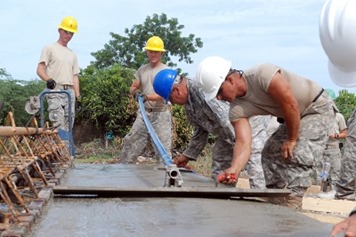
100622-A-4015L-019


Density of Materials:
Sr.No.
Material
Density
1
Bricks
1500-1800
2
Cement
1440
3
Cement mortar
2080
4
Lime
640
5
Lime mortar
1760
6
Concrete (P.C.C)
2400
7
Concrete (R.C.C)
2500
8
Steel
7850

De-Shuttering time of different RCC Members:

De-shuttering period relates to the maturity of concrete and depends on the ambient temperature. Forms shall not struck until the concrete has reached strength at least twice the stress of which the concrete may be subjected at the time of removal of form work.
Assuming standard conditions of workmanship and quality of materials, you can refer to the following time-frames for the removal of forms.
Form
Summers
Winters (Temp <18° C)
Walls, columns and vertical faces of structural members
24 hrs.
48 hrs.
Removal of props under slab Spanning up to 4.5 m
7 days
14 days
Removal of props under beams and arches spanning up to 6 m
14 days
28 days


Cube samples required for different quantity of concrete:
Quantity of Concrete
No. of cubes required
1 – 5 m3
1 No’s
6 - 15 m3
2 No’s
16 – 30 m3
3 No’s
31 – 50 m3
4 No’s
Above 50 m3
4 + 1 No’s of addition of each 50 m3